Let's put a plan to your ambition
What day does your month become profitable?
A founder-friendly way to explain break-even by turning monthly fixed costs and gross margin into a memorable break-even day.
Most business owners have heard of break-even. Fewer can feel it.
A break-even number sitting in a spreadsheet is technically useful, but it doesn’t always change behaviour. Telling the team the business needs $139,000 of revenue to break even this month might produce a polite nod. Telling them the business usually starts making money on the 18th might resonate better.
That’s the Break-Even Day.
Most business owners have heard of break-even. Fewer can feel it.
A break-even number sitting in a spreadsheet is technically useful, but it doesn’t always change behaviour. Telling the team the business needs $139,000 of revenue to break even this month might produce a polite nod. Telling them the business usually starts making money on the 18th might resonate better.
That’s the Break-Even Day.
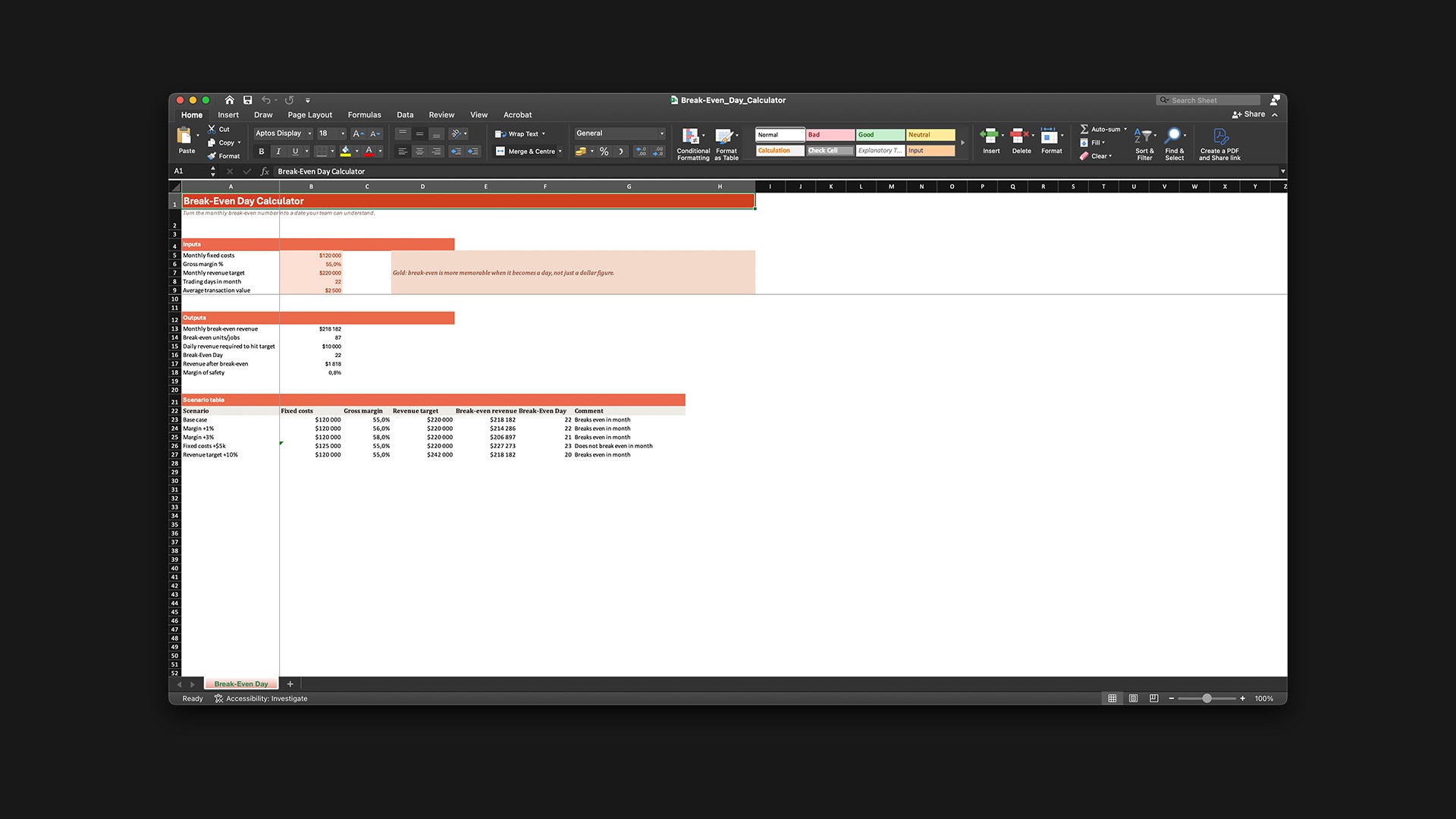
Image Caption
The basic formula
Monthly break-even revenue equals monthly fixed costs divided by gross margin percentage.
If fixed costs are $120,000 and gross margin is 55%, the monthly break-even revenue is about $218,182.
If the revenue target is $300,000 across 22 trading days, then the break-even day is approximately day 16.
That means the first 16 trading days are mostly paying for the month. After that, the business is creating profit and buffer.
Monthly break-even revenue equals monthly fixed costs divided by gross margin percentage.
If fixed costs are $120,000 and gross margin is 55%, the monthly break-even revenue is about $218,182.
If the revenue target is $300,000 across 22 trading days, then the break-even day is approximately day 16.
That means the first 16 trading days are mostly paying for the month. After that, the business is creating profit and buffer.
Why this works
Some humans understand dates better than abstract finance terms.
Break-Even Day gives owners a simple operating question: are we ahead or behind the day?
If the business normally reaches break-even on day 16 but it’s already day 20 and sales are behind, the team knows the month is under pressure. If it reaches break-even on day 12, the business has more room to invest, pay down debt, build reserves or absorb surprises.
The one bit of gold
A small improvement in gross margin can move Break-Even Day earlier without adding any extra sales.
That is why pricing, mix and delivery efficiency matter so much. A business doesn’t always need more revenue. Sometimes it needs better revenue.
For example, a business with $120,000 of fixed costs and 50% gross margin needs $240,000 to break even. If gross margin improves to 55%, break-even revenue drops to about $218,182. That’s over $21,000 less revenue needed before the month starts building profit.
Some humans understand dates better than abstract finance terms.
Break-Even Day gives owners a simple operating question: are we ahead or behind the day?
If the business normally reaches break-even on day 16 but it’s already day 20 and sales are behind, the team knows the month is under pressure. If it reaches break-even on day 12, the business has more room to invest, pay down debt, build reserves or absorb surprises.
The one bit of gold
A small improvement in gross margin can move Break-Even Day earlier without adding any extra sales.
That is why pricing, mix and delivery efficiency matter so much. A business doesn’t always need more revenue. Sometimes it needs better revenue.
For example, a business with $120,000 of fixed costs and 50% gross margin needs $240,000 to break even. If gross margin improves to 55%, break-even revenue drops to about $218,182. That’s over $21,000 less revenue needed before the month starts building profit.
How to use the calculator
Start with monthly fixed costs. Include wages that do not directly move with sales, rent, software, admin, insurance, finance costs and other overheads.
Then enter gross margin percentage. For service businesses, this usually means revenue less direct labour and direct costs. For product businesses, it usually means revenue less cost of goods sold.
Then enter the monthly revenue target and trading days.
The calculator will show monthly break-even revenue, units or jobs required, daily revenue required and the Break-Even Day.
Use it as a conversation starter
The point isn’t to bully the team with a number. It’s to make the economics visible.
Ask:
What moves break-even earlier?
Which customers or products drag it later?
Which fixed costs have crept in without a decision?
Are we measuring gross margin properly?
What is the earliest warning sign that the month is slipping?
Start with monthly fixed costs. Include wages that do not directly move with sales, rent, software, admin, insurance, finance costs and other overheads.
Then enter gross margin percentage. For service businesses, this usually means revenue less direct labour and direct costs. For product businesses, it usually means revenue less cost of goods sold.
Then enter the monthly revenue target and trading days.
The calculator will show monthly break-even revenue, units or jobs required, daily revenue required and the Break-Even Day.
Use it as a conversation starter
The point isn’t to bully the team with a number. It’s to make the economics visible.
Ask:
What moves break-even earlier?
Which customers or products drag it later?
Which fixed costs have crept in without a decision?
Are we measuring gross margin properly?
What is the earliest warning sign that the month is slipping?
What to do this week
What to do this week
Find your current Break-Even Day. Then run two scenarios: gross margin up 3%, and fixed costs up $5,000. Those two cases will teach you more about your business than a generic profit target. F
Website disclaimer note: This article provides general information only and does not take into account your circumstances. It is not a substitute for tax, legal, financial, employment, cyber security or other professional advice.
Find your current Break-Even Day. Then run two scenarios: gross margin up 3%, and fixed costs up $5,000. Those two cases will teach you more about your business than a generic profit target. F
Website disclaimer note: This article provides general information only and does not take into account your circumstances. It is not a substitute for tax, legal, financial, employment, cyber security or other professional advice.
Share this post
Got questions?
Maybe it’s time for a
macchiato with Chris.

Got questions?Maybe it’s time for a macchiato with Chris.
Got questions?
Maybe it’s time for a
macchiato with Chris.
Ready to kick-start your
self-made journey?

© 2026 Denari Advisory. Liability limited by a Scheme approved under Professional Standards Legislation.
Strategy and Site by Touching Base
Ready to kick-start your self-made journey?
© 2026 Denari Advisory. Liability limited by a Scheme approved under Professional Standards Legislation.
Strategy and Site by Touching Base
Ready to kick-start your
self-made journey?
© 2026 Denari Advisory. Liability limited by a Scheme approved under Professional Standards Legislation.
Strategy and Site by Touching Base
